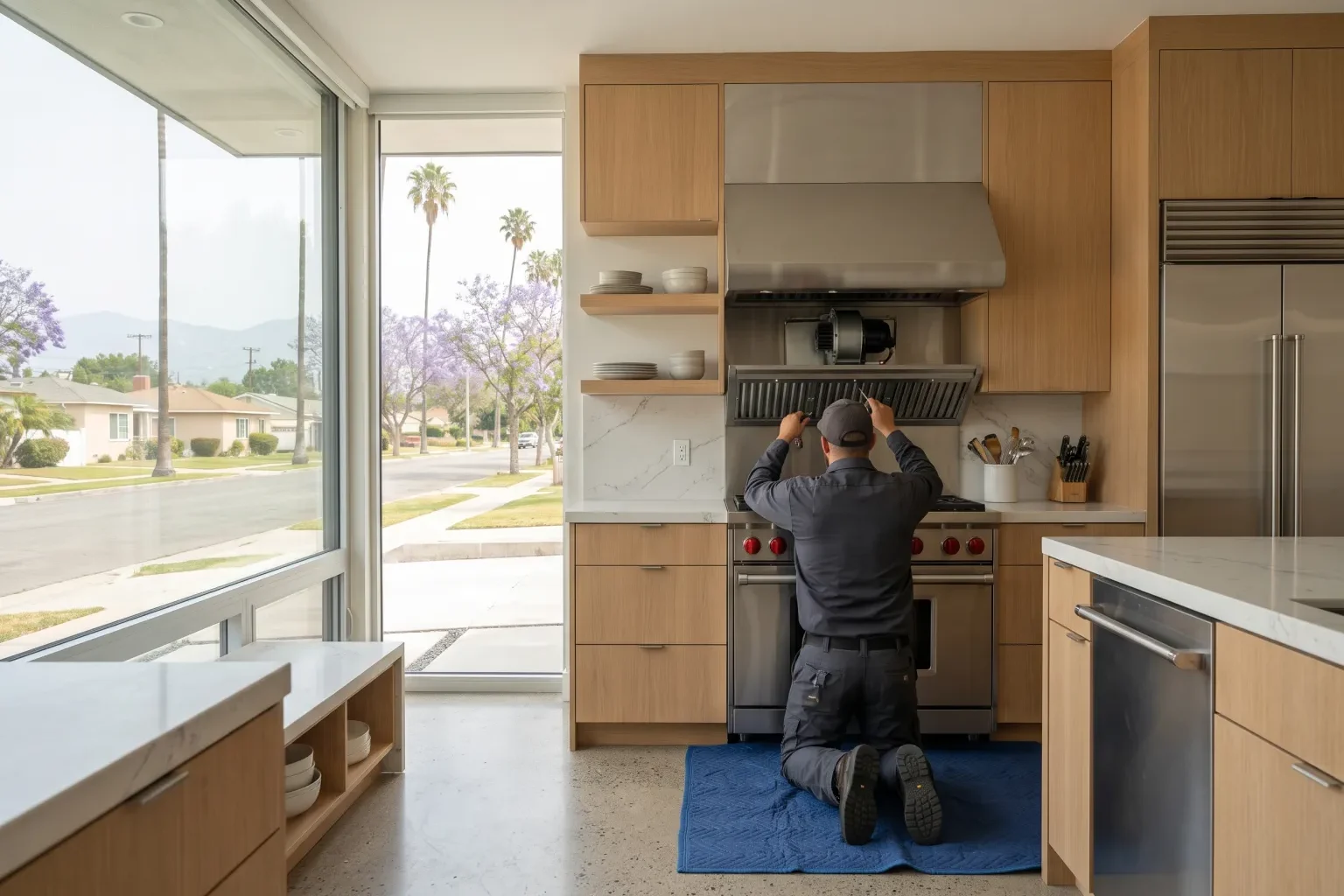



The short answer
Most range hood problems come from a failed blower motor, capacitor, control board, switch, light socket or stuck damper, and nearly all of them can be repaired without replacing the hood. On a high-end unit, repair usually makes sense unless the housing is damaged or parts are no longer available.
A range hood is easy to ignore until it fails. Then smoke lingers, grease settles on cabinets, and the kitchen holds onto last night's dinner. We repair built-in, wall-mount, island, insert and downdraft ventilation in Glendale and surrounding cities. Many of the kitchens we work in pair a Sub-Zero refrigerator with Viking, Wolf or Thermador cooking and ventilation, and we service all four brands. Gleadale Appliance services is independent and not affiliated with any manufacturer. We find out why your hood stopped working, explain what we found in plain terms, and fix it with the right parts.
Issues we fix
These are the symptoms homeowners usually call about. Some point to one specific part, and others can have several causes, so we test before we replace anything.
- Fan won't turn on at any speed, or the hood has no power at all
- Weak suction: smoke and steam escape past the hood even on high
- Loud humming, rattling, grinding or a wobble from the blower
- Fan stuck on one speed, or it won't shut off
- Lights flicker, stay dark or burn out quickly
- Buttons or touch controls don't respond, or indicator lights blink
- Hood switches on by itself because of a heat sensor or control fault
- Grease dripping from the hood or the filters
- Cold air or outside odors coming in through the duct when the hood is off
- Downdraft vent that won't rise, lower or stay up
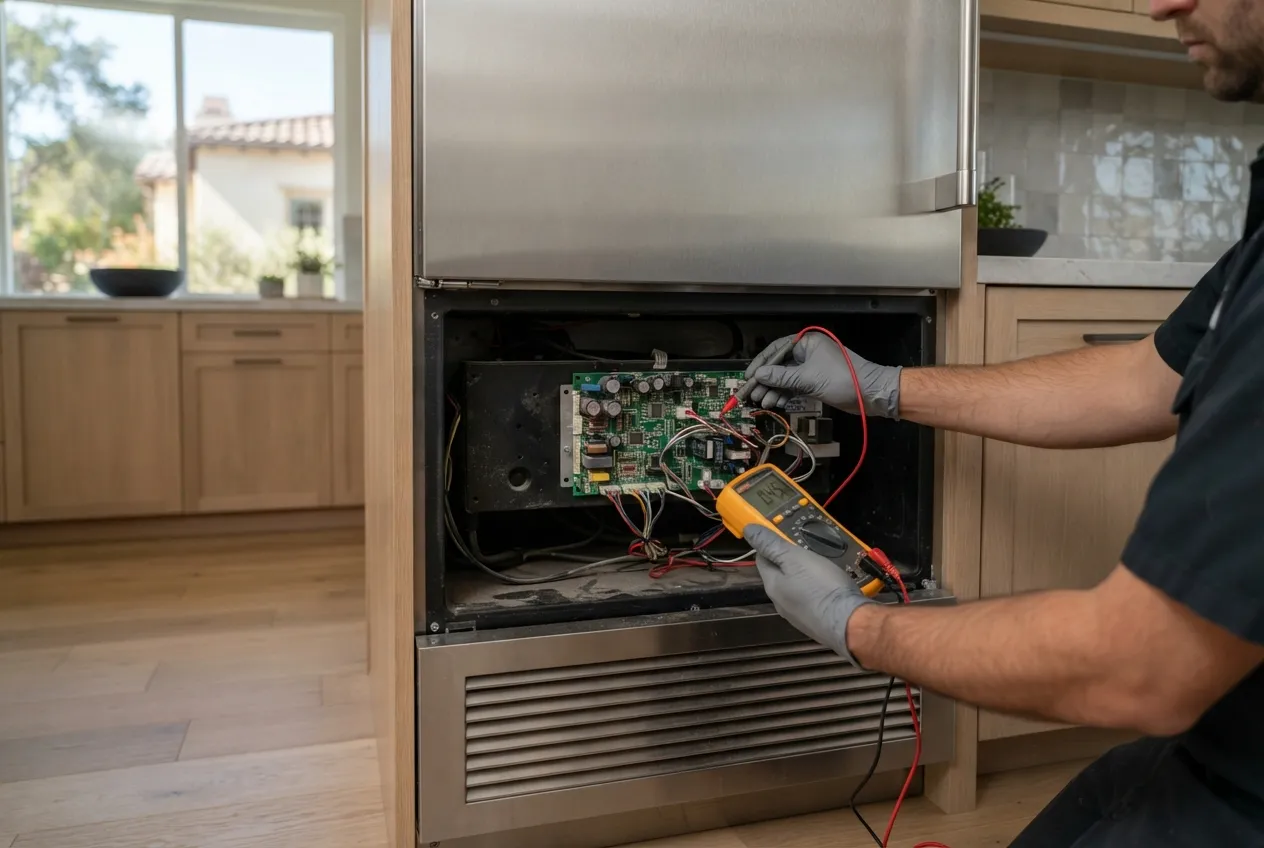
What our technician checks on a built-in or professional-style hood
We start with power: the circuit, the junction box and the voltage reaching the hood. A surprising number of 'dead' hoods are a tripped breaker or a loose connection. Then we work through the controls, testing the switches or touch panel and the control board to see whether they're sending the correct signal to the fan and lights.
Next comes the blower. We check the motor windings, the run capacitor, the bearings and the blower wheel. A wheel caked with grease runs out of balance, gets noisy and moves less air. If the blower is mounted remotely, in-line in the duct or on the roof or an exterior wall, we trace the wiring and inspect that unit as well.
We also look at airflow beyond the hood. That means the baffle or mesh filters, the backdraft damper, and whatever duct we can reach without opening walls. A damper that's stuck closed or a crushed duct can make a healthy motor look weak. On downdraft models we also check the lift motor, the limit switches and the track.
How Sub-Zero, Viking, Wolf and Thermador ventilation differs
Sub-Zero focuses on refrigeration, so in most homes we visit it's the refrigerator a few steps from the cooktop rather than the hood itself. We often service both on the same visit. On the ventilation side, each brand's design shapes what tends to fail.
Viking professional-style hoods are built around powerful blowers and often use straightforward mechanical or electronic switches. Their common problems are usually physical: worn motor bearings, failed capacitors, burned-out lights and switches that wear out with daily use. Grease buildup in the blower wheel and baffles adds to the strain.
Wolf offers wall, island and insert hoods as well as downdraft systems, and many installations use a separate in-line or remote blower. On those setups the fault may sit far from the hood, in the blower or the wiring between them. Electronic controls and downdraft lift mechanisms bring their own control and switch issues.
Thermador hoods and downdraft units lean more on electronic controls, so we spend more diagnostic time on control boards, touch panels and sensors. Downdraft models also have a lift motor and travel switches that can wear or fall out of alignment.
Tell us what your appliance is doing.
Repair or replace a high-end range hood?
For most premium hoods, repair is the sensible choice. The stainless housing, liner and ductwork usually outlast the parts inside them, and motors, capacitors, switches, boards and lights are all replaceable. Replacing a custom-fit hood can also mean reworking cabinetry, ducting or a decorative surround, which adds disruption that a repair avoids.
Replacement is worth considering when the housing is badly corroded or damaged, when key parts are discontinued and no workable substitute exists, or when you're remodeling and want a hood with more capacity or a different style. If we think replacement makes more sense than repair, we'll tell you and explain why.
What affects the cost of range hood repair
We can't give a fair figure until we know what's wrong, but these are the factors that decide it. The first is the fault itself. A loose wire or a light socket is a smaller job than a blower motor or a control board. The second is parts: availability, whether the part is specific to your model, and whether it has to be ordered.
Access matters a great deal on high-end installations. A hood behind a custom wood surround, a liner insert built into cabinetry, or a remote blower in an attic or on a roof all take more time to reach safely. Heavy grease buildup that has to be cleaned before we can work, and downdraft units mounted below the countertop, also add labor. We explain our findings and the repair before any work begins.
How a visit works
When you contact us, have the brand, the model and serial number (usually on a label behind the filters) and a description of the symptom ready. That helps us bring the most likely parts.
At your home, the technician confirms the problem, tests the power, controls, blower and airflow, and then walks you through the cause and the repair. If a part has to be ordered, we schedule a return visit to install it. Once the repair is done, we run the hood through every speed and the lights, check the damper and clean up the work area. We'll also mention any upkeep, like filter cleaning, that will help the hood keep working well.