


The short answer
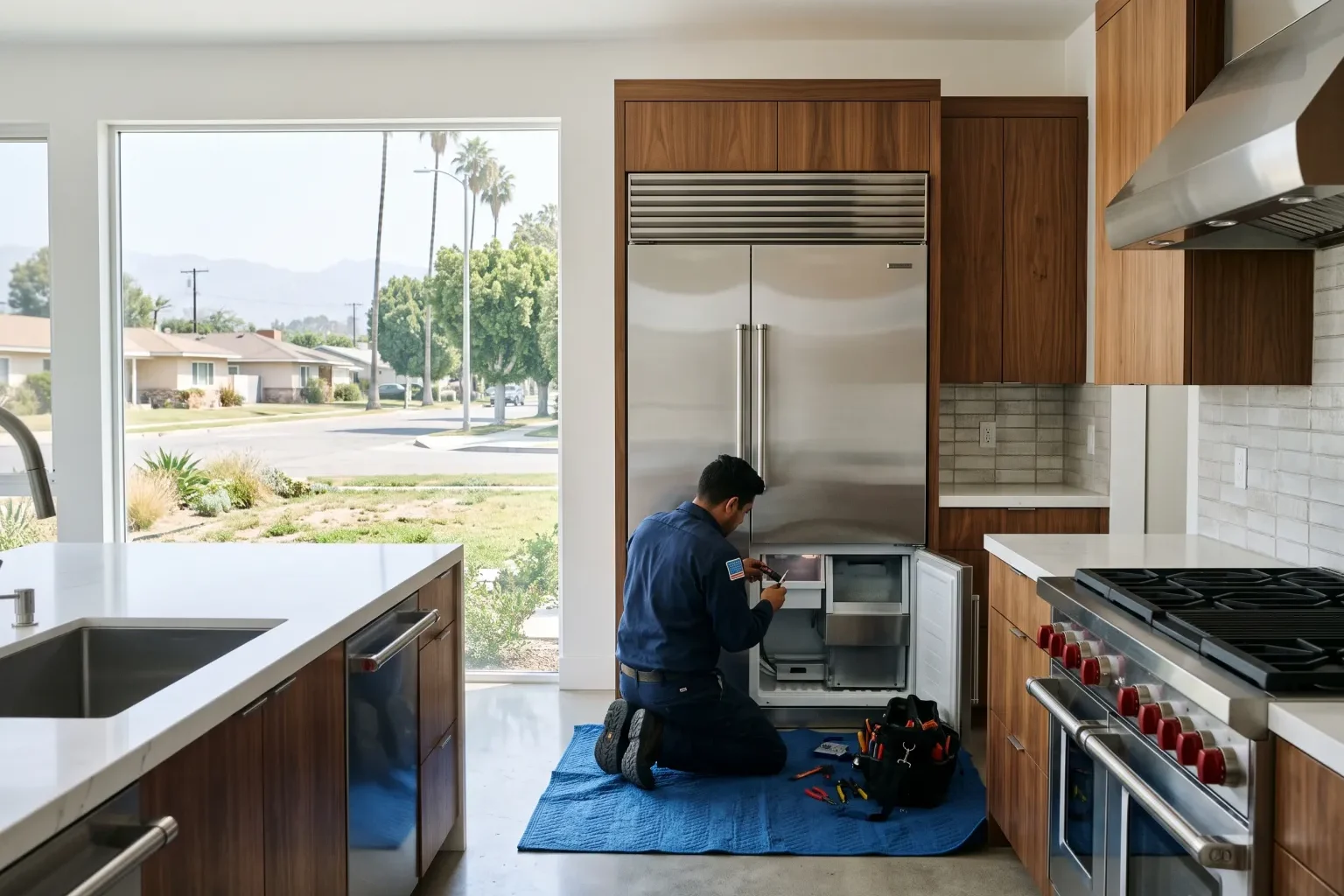
Most ice maker problems on built-in refrigerators come from the water supply, a frozen fill tube, a failed inlet valve, or a freezer that isn't holding temperature, and most are repairable. Our technician tests the water line, valve, ice maker module and freezer before recommending any parts, so you only pay for repairs that fix the actual cause.
When the ice maker in a built-in refrigerator stops working, it is easy to ignore for a day or two. But an ice maker that quits is often an early sign of a water supply problem, a freezer temperature issue, or a leak that can damage custom cabinetry and flooring. Gleadale Appliance services repairs ice makers in high-end kitchens across Glendale and nearby cities. We focus on Sub-Zero built-in and undercounter units, and we also work on Viking and Thermador refrigeration in kitchens built around Wolf, Viking and Thermador cooking equipment. We are an independent repair company with no affiliation to any manufacturer. Below you'll find the symptoms we see most, what our technician checks, how the brands differ, and what to expect from a visit.
Issues we fix
Ice makers usually give warning signs before they stop completely. If you notice any of the following on a built-in, column or undercounter unit, it's worth having it looked at before a small problem becomes a leak or a larger repair.
- No ice at all, even though the refrigerator and freezer seem cold
- Slow production, where the bin never fills the way it used to
- Small, thin, hollow or misshapen cubes, which often point to low water flow
- Ice frozen into a solid block or clumps in the bin
- Water leaking under the unit, inside the freezer, or onto the floor in front of the cabinetry
- Frost or ice build-up around the ice maker, fill tube or freezer walls
- Ice that tastes or smells off, or cubes that look cloudy
- Flashing lights, service indicators or error codes on the control panel
- Undercounter ice machines that won't drain, overflow, or make clicking and buzzing sounds
What our technician checks on a built-in unit
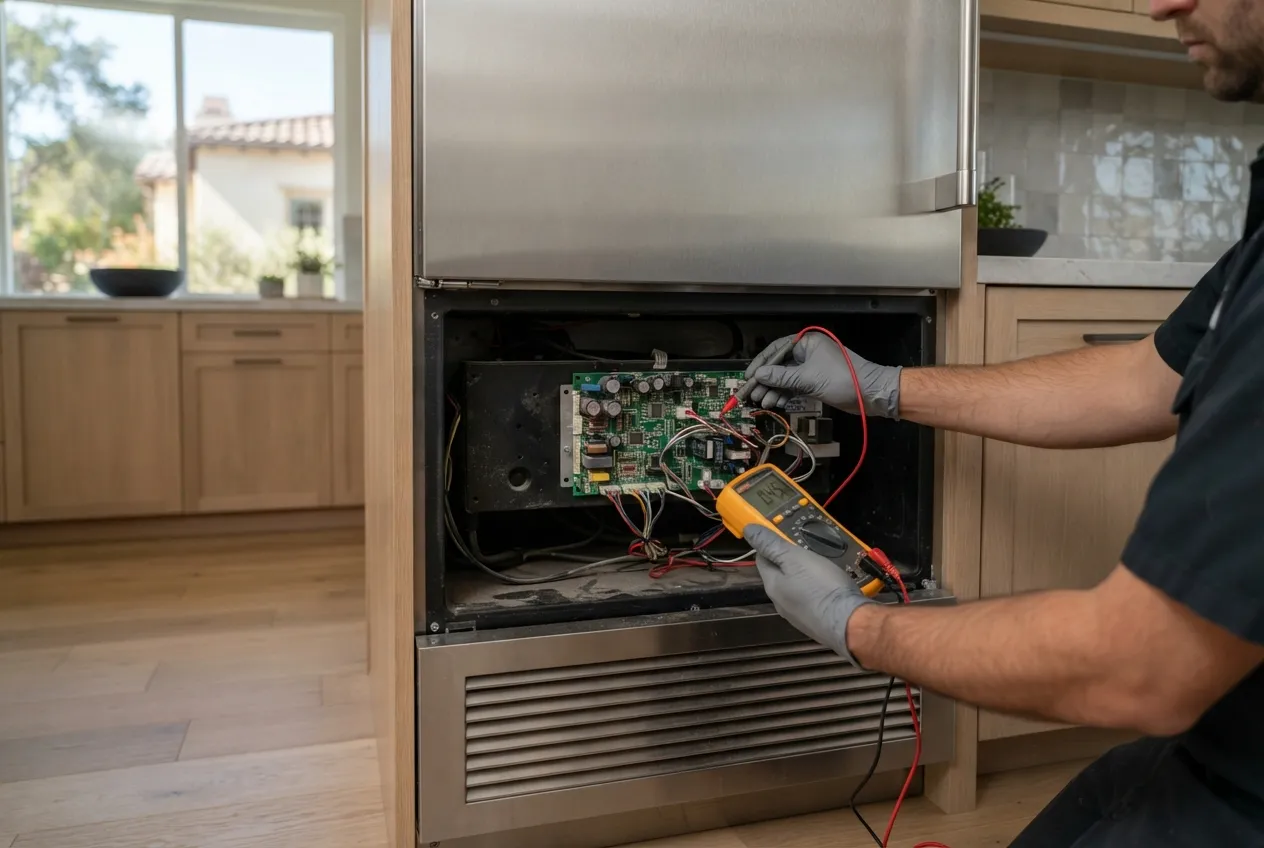
Built-in and professional-style refrigerators are designed to sit flush with cabinetry, so the ice maker, water valve and supply line are often harder to reach than on a freestanding model. Our technician starts with the simplest causes: the household shutoff valve, the water line behind or beneath the unit, the water filter, and incoming water pressure. A clogged filter or a partly closed valve is a common reason for small cubes and slow production.
From there, we test the water inlet valve, inspect the fill tube for ice blockages, and check the ice maker module itself, including the mold heater, ejector motor and the arm or sensor that tells the unit when the bin is full. Because an ice maker depends on a properly cold freezer, we also measure freezer temperature and look at the evaporator fan, defrost system, condenser coils and door gaskets. On undercounter ice machines, we check the drain line, drain pump if equipped, water distribution and scale build-up. Glendale sits inland, where summers run much hotter than near the coast, and dusty condenser coils or a cramped installation can push a refrigerator harder during those months, which shows up first as slow ice production.
How Sub-Zero, Viking, Wolf and Thermador ice makers differ
Sub-Zero makes built-in, column and integrated refrigerators with ice makers, along with dedicated undercounter ice machines. On the refrigerators, we often trace problems to the water valve, a frozen fill tube, or a filter that hasn't been changed. Sub-Zero undercounter ice machines are more sensitive to water quality and drainage, so scale build-up and drain issues come up more often.
Viking built-in refrigerators and undercounter ice machines tend to show similar water-side failures, and on older units we also see ice maker modules and door gaskets wearing out. Thermador's column refrigerators place the ice maker inside a tall, narrow freezer column, so access and airflow inside that column matter when diagnosing slow or uneven production.
Wolf is a cooking brand and does not make ice makers, but many Glendale kitchens pair a Wolf range with a Sub-Zero refrigerator. When we visit for an ice maker, we can also look at a Wolf range, cooktop or oven during the same appointment if you mention it when booking.
Tell us what your appliance is doing.
Repair or replace a high-end ice maker?
On a premium built-in refrigerator, repair is usually the practical choice. Most ice maker faults involve a single component, such as a valve, module, sensor or fan, and replacing the whole refrigerator means matching cabinet openings, custom panels and water connections. A refrigerator that cools well with a failed ice maker is almost always worth fixing.
Replacement makes more sense when the refrigerator also has sealed-system problems, such as a failing compressor or refrigerant leak, when needed parts are no longer available, or when repeated repairs are adding up on an older unit. Our technician will explain what failed, what else looked worn, and give you an honest view of both options before any work begins.
What affects the cost of ice maker repair
We don't quote a price before diagnosing the unit, because the same symptom can have very different causes. These are the main factors that shape the cost of a repair:
- The actual fault, from a clogged filter to a failed ice maker module or freezer problem
- Parts required and whether they are in stock or need to be ordered
- Access, including panel-ready doors, tight cabinet openings, and units that must be pulled out to reach the water line
- Whether there is water damage or more than one failed component
- Undercounter machines that need descaling or drain line work in addition to the repair
How a service visit works
When you contact us, tell us the brand, model if you have it, and what you're seeing, such as no ice, leaking or an error code. That helps our technician bring likely parts. At your home, the technician protects floors and finished panels, runs a full diagnosis, and explains the cause in plain terms along with your repair options.
Nothing is repaired without your approval. If the needed part is on hand, the repair can often be done during the same visit. If a part has to be ordered, we schedule a return trip. Before leaving, the technician confirms the ice maker is filling and cycling and the area around the unit is dry.